First Release · v1.0
NaviGS
3D Gaussian Splatting Dataset of Real-World Scenes
120
High-Fidelity Scenes
50,000+
Square Meters Covered
10+
Scene Categories
3D Gaussian Splatting Dataset of Real-World Scenes
Existing 3D scene datasets face significant limitations. Real-world datasets reconstructed from RGB-D scans often suffer from occlusions and incomplete spatial coverage, while simulated datasets exhibit a domain gap from real-world environments and are typically limited in scene complexity, with insufficient diversity in scene categories.
To address these limitations, we introduce NaviGS, a real-world dataset comprising high-fidelity 3D Gaussian Splatting (3DGS) representations and meshes. Based on the reconstructed 3DGS, we render high-quality RGB images and depth observations from different viewpoints. Furthermore, NaviGS facilitates research on spatial intelligence and supports a range of downstream tasks, including 3D scene understanding, controllable scene generation, and embodied agent navigation.
NaviGS contains 120 high-fidelity scenes covering more than 50,000 m², spanning more than 10 scene categories, including meeting rooms, offices, classrooms, gyms, residential environments, corridors, exhibition halls, and outdoor gardens. In its initial release, we will provide five RGB scenes and five semantic scenes.
All scenes captured in real environments, eliminating the sim-to-real domain gap that plagues synthetic datasets.
For a subset of scenes, we release hierarchical 3D scene graphs following the floor–room–stuff–object structure.
Five RGB scenes and five semantic scenes are now available, with the full 120-scene corpus coming soon.
Each scene in NaviGS comes with a comprehensive set of data modalities, supporting a wide range of research directions.
High-quality color images rendered from reconstructed 3DGS across multiple viewpoints.
All ScenesPrecise camera pose parameters for each rendered view, enabling spatial reasoning.
All ScenesInitial point cloud for 3DGS reconstruction.
All ScenesAccurate depth maps rendered from 3DGS, providing dense geometric information.
All ScenesRaw 3D Gaussian Splatting representations for novel view synthesis and editing.
All ScenesReconstructed 3D mesh models for geometry-based applications and simulation.
All ScenesHierarchical 3D scene graphs with floor–room–stuff–object structure and relationships.
Semantic ScenesFive semantic scenes are available in the first release, each with rendering videos and hierarchical scene graphs.
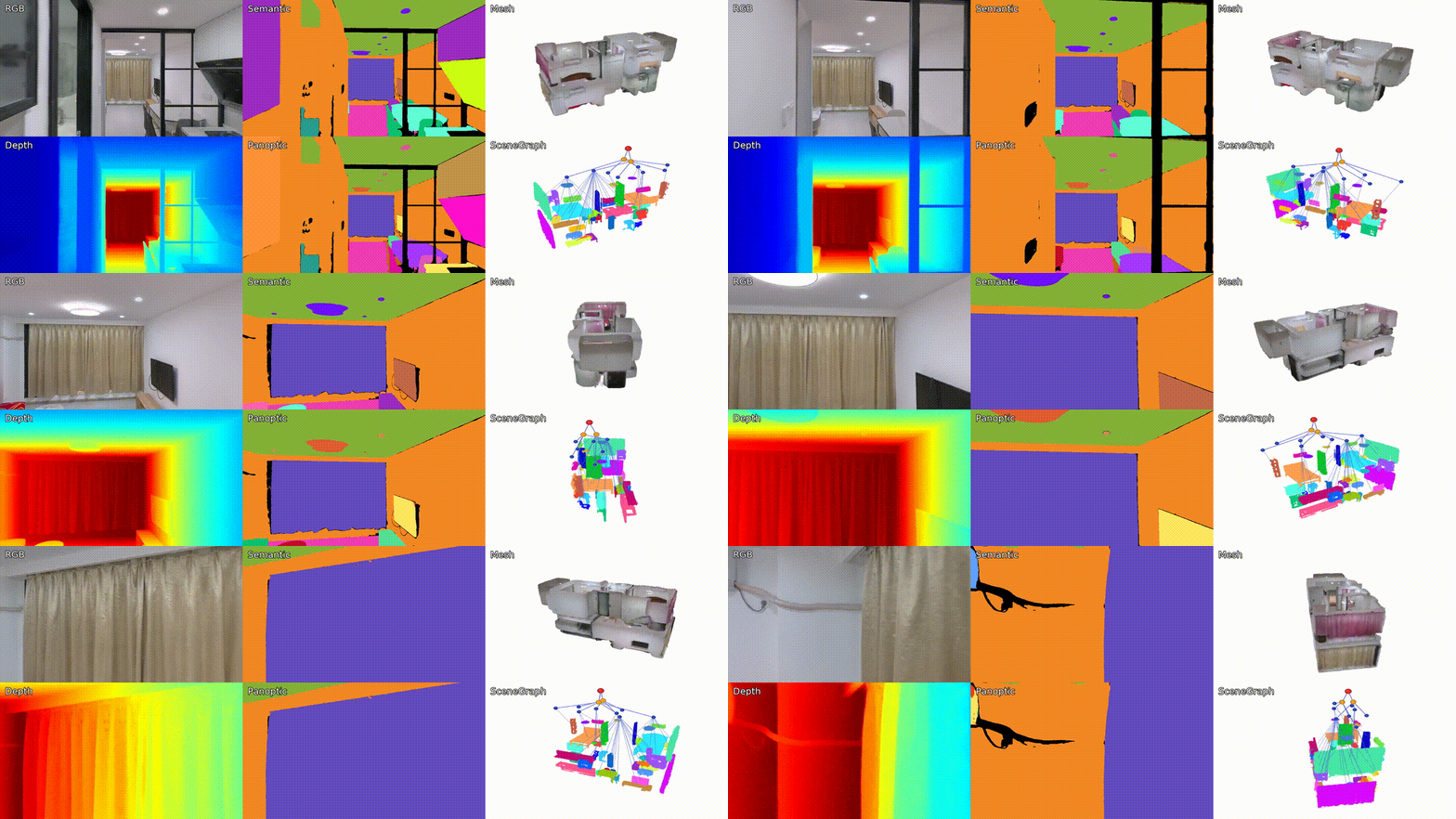
A multi-room indoor environment with detailed object-level annotations and hierarchical scene graph structure. The scene graph captures spatial relationships between furniture, fixtures, and architectural elements.
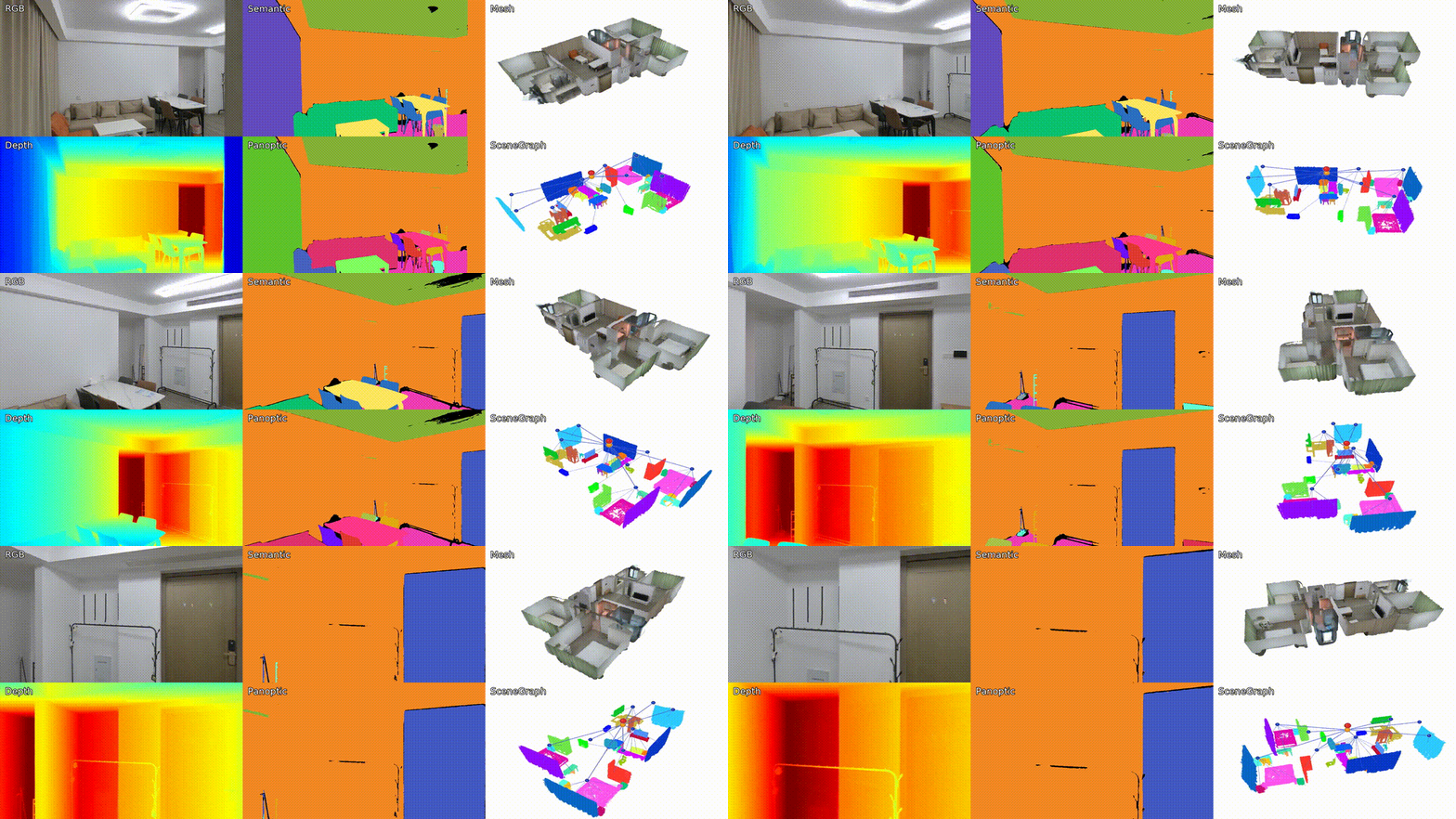
An indoor living space featuring beds, chairs, and various household objects. The scene graph provides a structured representation of object placements and inter-object relationships across the environment.
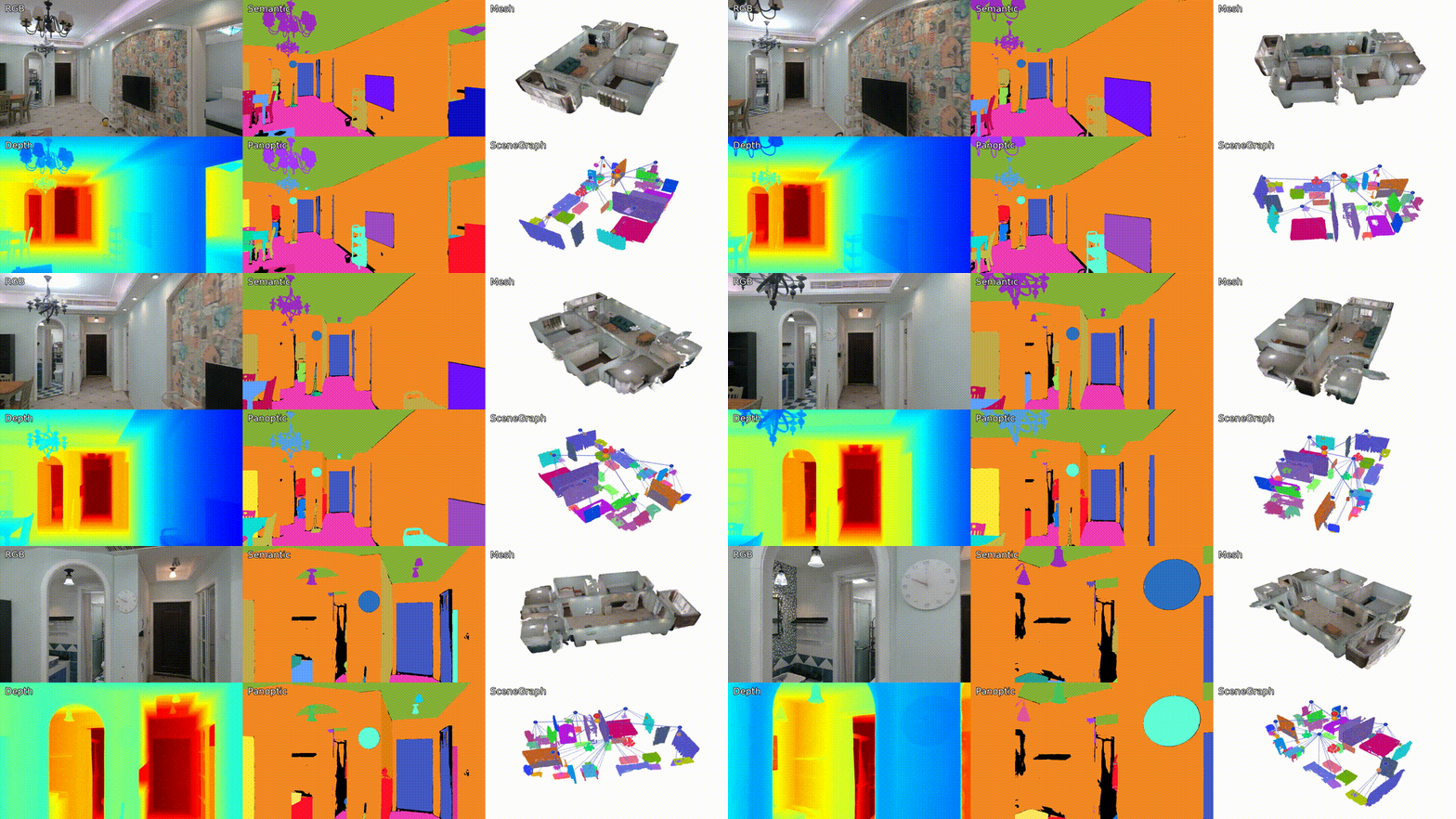
A complex multi-object scene with diverse furniture arrangements. The hierarchical scene graph organizes the space from room-level down to individual object instances with rich relational edges.
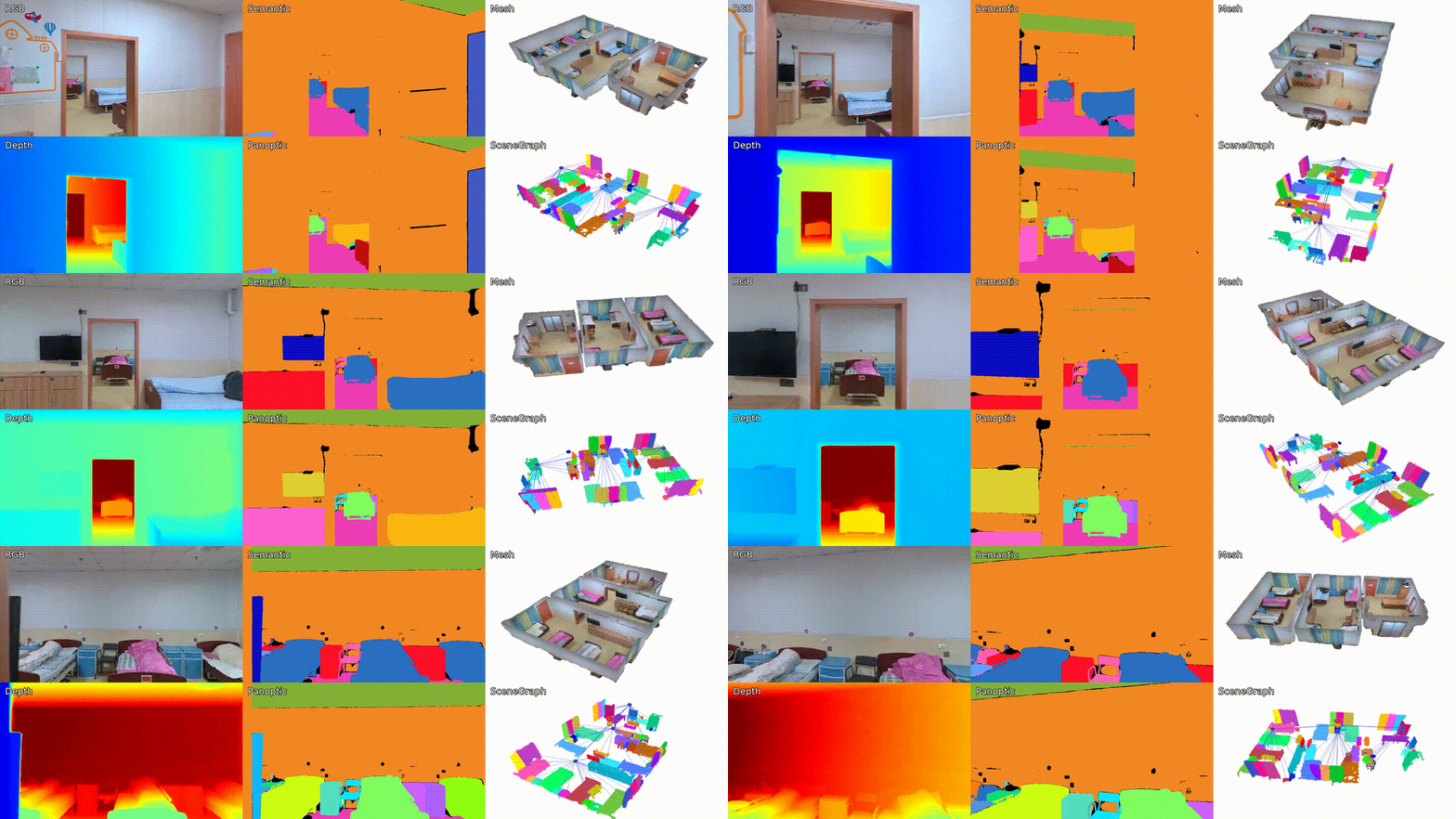
A residential rest home environment with multiple connected spaces. The scene graph captures the floor–room–stuff–object hierarchy, enabling research in long-horizon navigation and spatial planning.
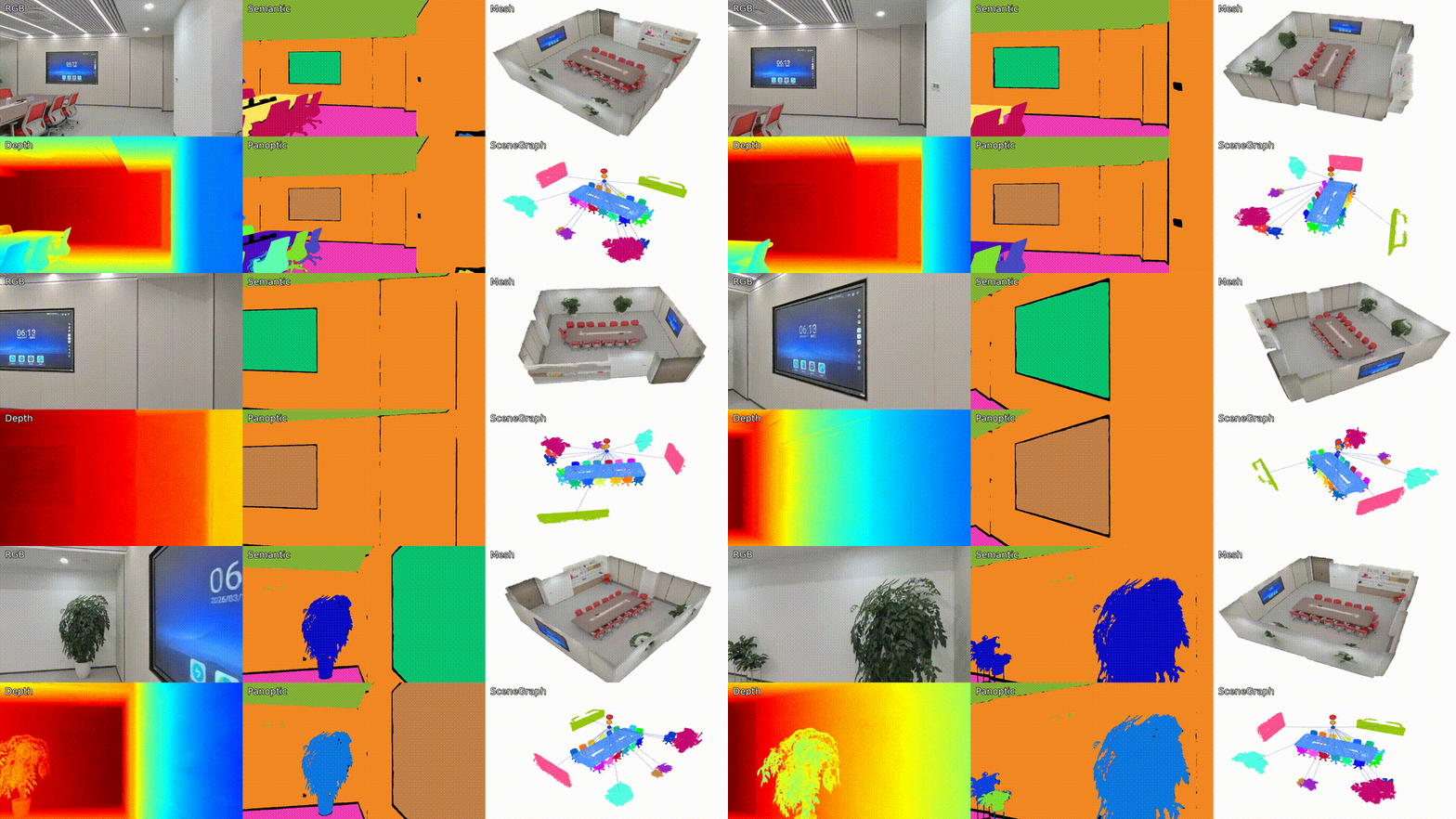
A professional meeting room with conference table, chairs, and presentation equipment. The scene graph encodes office object relationships suitable for embodied agent navigation and task planning research.
NaviGS supports a broad range of downstream tasks in 3D vision and embodied AI.
Multi-modal annotations enable research in scene parsing, object detection, semantic segmentation, and structural reasoning.
3DGS representations and scene graphs provide a foundation for text-driven scene editing, layout generation, and novel view synthesis.
Real-world multi-room scenes with hierarchical graphs support long-horizon navigation, VLA models, and spatial planning research.
If you use NaviGS in your research, please cite: